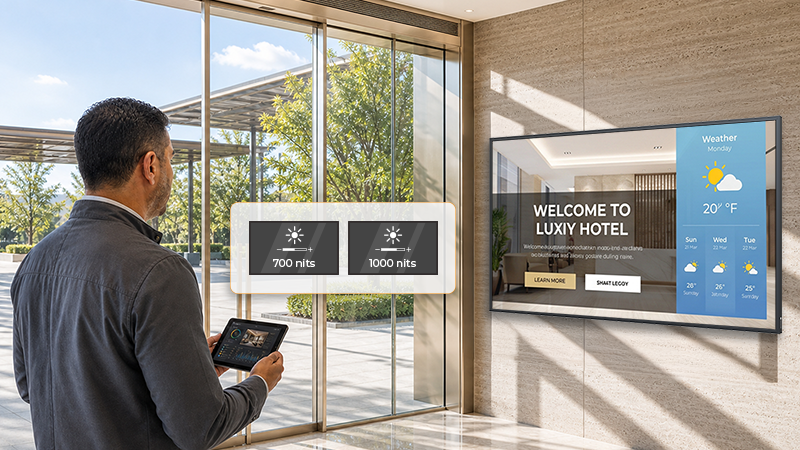
Choosing 700 vs 1000 nits displays for digital signage depends on the real installation environment—not simply the highest nit rating. For system integrators, facility teams, and businesses, it can affect installation confidence, content visibility, and long-term satisfaction after the display is installed.
A screen may look clear during a demonstration or site visit, but perform differently in the final location. Bright lobbies, glass entrances, retail front areas, atriums, and spaces with strong overhead lighting can introduce daylight, reflections, and changing ambient light that reduce readability.
When a screen appears washed out after deployment, the issue can lead to additional site adjustments, difficult client conversations, or an unplanned display upgrade. The key is to assess whether 700 nits provides enough brightness for the real environment—or whether a 1000 nit display offers the safer specification choice.
This guide compares 700 vs 1000 nits for digital signage and explains when each brightness level fits best for bright indoor commercial projects.
A nit is a unit used to describe display brightness. Technically, one nit is equal to one candela per square meter, written as cd/m². This is why some display datasheets list brightness as “nits,” while others use “cd/m².”
For example, 700 nits is the same as 700 cd/m², and 1000 nits is the same as 1000 cd/m².
For digital signage, brightness matters because the display must remain readable against surrounding light. Ambient light does not reduce the display’s actual nit rating, but it can reduce perceived contrast and readability. In brighter indoor locations, daylight, glass reflections, overhead lighting, and reflective surfaces can make dark areas look washed out and make content harder to read.
The goal is not to choose the highest possible brightness. It is to select enough brightness to maintain clear readability in the actual installation environment.
Consumer TVs and many entry-level business displays are designed primarily for controlled indoor viewing. They may not be suitable for signage applications that require higher brightness, long operating hours, portrait installation, remote management, or reliable performance in bright commercial spaces.
This article focuses on professional digital signage brightness levels, especially the difference between 700-nit and 1000-nit commercial displays. For a full comparison between TVs and commercial displays, that topic is better handled in a separate guide.
Read More: Commercial Display vs Consumer TV for Digital Signage
A 700-nit display is suitable for many mainstream commercial signage projects. It provides stronger brightness than a standard indoor display and works well in locations where lighting is relatively stable and controlled.
Typical applications include:
A 700-nit display should not be considered a compromise. It is often the right solution when the screen is installed away from direct daylight, highly reflective glass, and high-ambient-light locations.
For signage projects, the final installation position matters more than the general building type. A display placed deeper inside a retail store may perform well at 700 nits. The same display installed beside a glass entrance or near a large window may require more brightness to achieve the same viewing experience.
A 1000 nit display becomes more relevant when the installation environment is brighter, less controlled, or more exposed to daylight.
It can be the better choice for:
The benefit of moving from 700 to 1000 nits is not simply a brighter-looking image. It is a stronger visibility margin when ambient light increases.
The move from 700 to 1000 nits adds 300 nits of brightness, or roughly 43% more peak luminance. This does not mean the display will appear 43% brighter to every viewer, and it does not eliminate glare or reflection. Instead, the added brightness provides more visibility margin in bright indoor spaces.
That margin becomes useful when ambient light increases reflections, reduces perceived contrast, causes viewers’ eyes to adapt to a brighter environment, or makes signage harder to read from a distance. In these conditions, a 1000-nit display can be a safer brightness choice than 700 nits, especially when the final installation environment is bright, glass-adjacent, or less predictable.
This is especially important for customer-facing content such as promotions, pricing, wayfinding, schedules, and public announcements. These messages need to remain easy to notice and understand during the brightest periods of the day, not only when the environment is dim or lighting conditions are ideal.
When comparing 700 vs 1000 nits, the best choice depends on the installation environment rather than the brightness number alone.
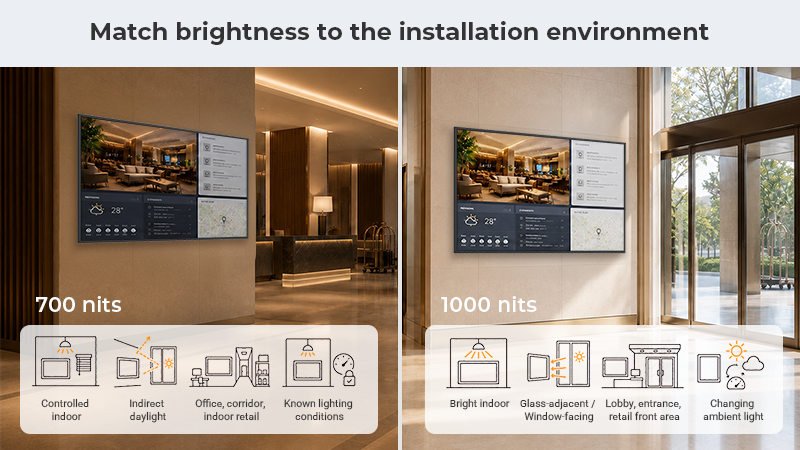
| Consideration | 700-Nit Display | 1000-Nit Display |
| Best-fit environment | Mainstream indoor commercial spaces | Bright indoor and window-facing commercial spaces |
| Ambient-light tolerance | Suitable for controlled or moderately bright interiors | Better suited to higher or changing ambient light |
| Near-window installation | Suitable when daylight is indirect and limited | More confidence for glass-adjacent and window-facing locations |
| Typical applications | Offices, restaurants, corridors, indoor retail | Retail front areas, lobbies, entrances, atriums, public areas |
| Content visibility | Clear in appropriate indoor conditions | Stronger visibility margin in brighter environments |
| Installation confidence | Best when site lighting is known and stable | Helpful when daylight and reflections are less predictable |
For a retail window display or a bright lobby, the difference between 700 and 1000 nits can affect how quickly viewers notice and understand the message. If the screen is seen through glass, near an entrance, or from a distance, it needs enough brightness and contrast to attract attention quickly.
Brightness is the primary factor in display visibility, but it is not the only one. Reflections from windows or overhead lighting, low-contrast content, screen surface, and installation angle can also affect readability. These factors should be reviewed during site assessment, but they should support—not replace—the appropriate brightness level for the installation.
Next step: Explore 1000-Nit Digital Signage for Bright Indoor Projects
Not every bright indoor project needs 2500 nits.
A 2500-nit display is generally more appropriate for outdoor, semi-outdoor, or direct-sunlight applications. These environments may require a sunlight readable display that can remain visible under significantly stronger ambient light. For outdoor installations, brightness should be assessed alongside enclosure design, thermal management, and weather protection.
A 2500-nit solution may be appropriate when:
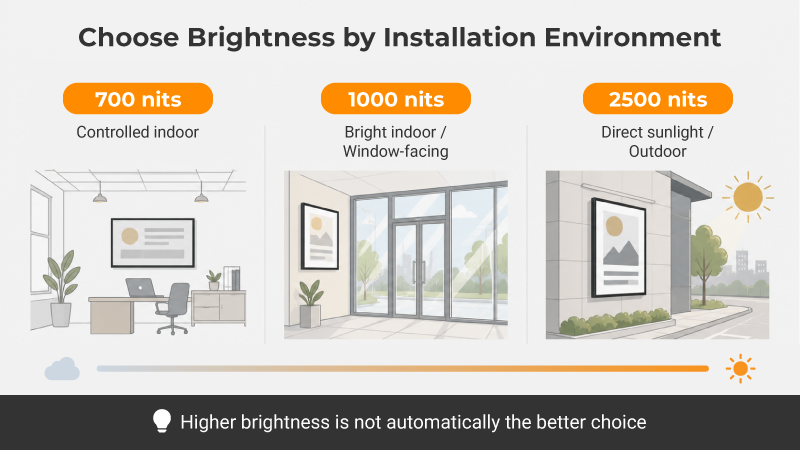
For most bright indoor display projects, a 1000-nit display may be the more appropriate step up from 700 nits. Selecting 2500 nits for an indoor location without direct sunlight may add cost without providing a proportional benefit.
When considering 1000 vs 2500 nits, start with the actual installation conditions. If the challenge is bright indoor visibility, glass entrances, or indirect daylight, 1000 nits may provide the right balance. If the challenge is direct sunlight or outdoor visibility, a sunlight readable display may be necessary.
The right digital signage brightness depends on the real installation environment, not simply on selecting the highest nit rating available.
For mainstream commercial signage in controlled indoor environments, 700 nits can be a practical and effective choice. For bright indoor spaces, retail front areas, glass entrances, and window-facing digital signage, a 1000-nit display can provide additional visibility margin and greater confidence that content will remain clear after installation.
A 2500-nit sunlight readable display should be considered when the screen will operate outdoors or receive direct sunlight. It is not automatically necessary for every bright indoor project.
Before finalising the display specification, assess the site during its brightest operating hours. Review daylight exposure, reflections, screen position, content contrast, viewing distance, and the expected operating schedule. This helps reduce installation risk and ensures the selected display supports both the project requirement and the client’s long-term expectations.
Next step: Select the Right High-Brightness Digital Signage Configuration for Your Project
Yes. A 700-nit display is suitable for many mainstream commercial signage applications, including controlled indoor environments, offices, restaurants, corridors, and retail interiors away from large windows. For brighter indoor or glass-adjacent locations, a 1000-nit display may provide more reliable visibility.
Choose a 1000-nit display when the screen will be installed in a bright indoor environment, near a glass entrance, in a retail front area, or in a window-facing location with changing daylight conditions. The additional brightness provides a stronger visibility margin.
A 1000-nit display can be suitable for bright indoor and window-facing retail applications, particularly when daylight is indirect. If direct sunlight regularly reaches the screen or the display faces outward toward the street, a higher-brightness sunlight readable display may be more appropriate.
A 1000-nit display is generally suited to bright indoor and window-facing commercial spaces. A 2500-nit display is more appropriate for direct sunlight, outdoor, or semi-outdoor environments where ambient light is significantly stronger.
System integrators should assess the site during its brightest operating hours. Review daylight exposure, window direction, reflections, screen position, viewing distance, content contrast, and whether lighting conditions may change throughout the day or across seasons.
It can be used near a window when daylight is indirect and the screen is not strongly affected by reflections or direct sunlight. For glass-adjacent or window-facing digital signage with higher ambient light, a 1000-nit display may provide a safer visibility margin.






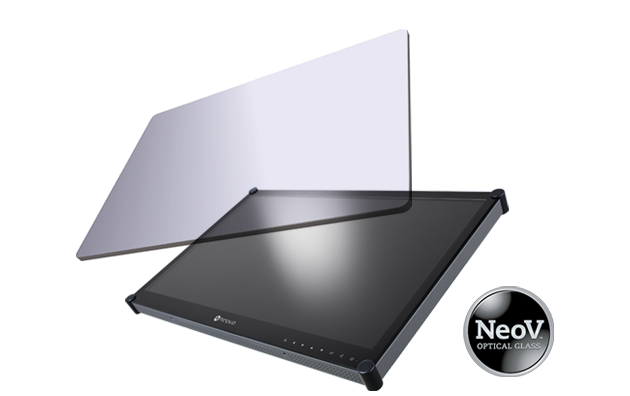 NeoV™ Optical Glass Screen
 Anti-Burn-in™ Technology