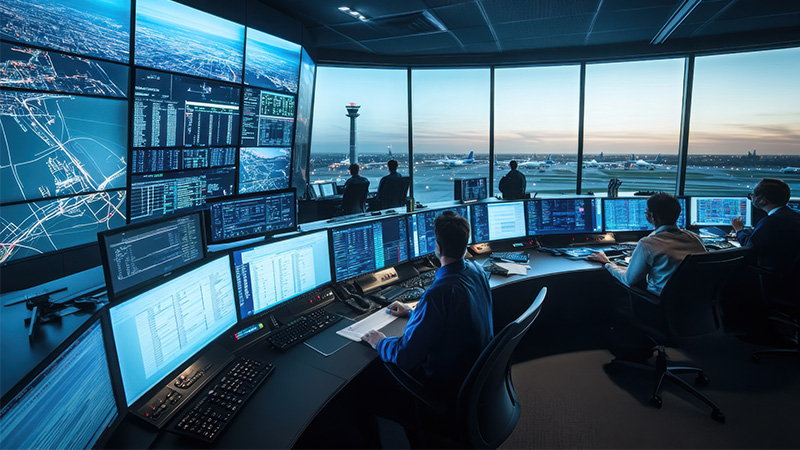

The best monitor for CCTV is not defined by peak resolution or screen size—it is defined by absolute reliability.
In professional surveillance environments, a display must operate continuously, maintain stable image clarity, and perform consistently under rigorous real-world electrical conditions. Choosing the wrong monitor inevitably leads to permanent image retention, rapid brightness loss, and severely reduced visibility—directly crippling security operations.
While many procurement officers begin by comparing consumer specifications such as 4K resolution, ultra-thin bezels, or panel type, these factors alone do not determine whether a display is suitable for commercial surveillance. The true foundational requirement is long-term operational endurance: ensuring that the screen continues to deliver accurate, forensic-level visuals over years of continuous use.
When tasked with finding the best monitor for security cameras, procurement officers and system integrators frequently make a critical miscalculation: treating the visual output as a standard IT accessory.
Millions of pounds are invested globally in 4K IP cameras, advanced Network Video Recorders (NVRs), and AI-driven Video Management Software (VMS). Yet, the entire infrastructure is rendered ineffective if the final endpoint—the display—fails to render that data accurately under relentless 24/7 electrical stress.
Deploying standard consumer monitors for commercial CCTV guarantees structural and operational failures, directly leading to:
This guide explains the exact technical benchmarks required for professional surveillance displays, illustrating why continuous operational endurance, surveillance-calibrated image processing, and robust system integration are essential for securing commercial environments.
Before evaluating technical specifications, it is critical to define the operational context and risk profile of your surveillance system.
For basic residential setups—such as a smart doorbell or a small number of perimeter cameras—a standard consumer monitor or television may be sufficient for casual, intermittent viewing.
However, commercial and enterprise environments operate under entirely different conditions. These systems must handle relentless 24/7 continuous operation, significantly higher liability and risk exposure, and much stricter reliability requirements.
In professional CCTV deployments, the best monitor is defined by two non-negotiable factors:
A professional display must ensure that a security operator viewing multiple camera feeds at any given time—day or night—receives consistent image clarity without degradation. It must also integrate seamlessly with both modern IP networks and legacy analogue systems while maintaining unwavering performance over its entire lifecycle.
Organisations often attempt to reduce initial capital expenditure by using office-grade monitors for their security control desks. This approach introduces severe, compounding long-term risks to the facility.
Panel Fatigue from Static Monitoring Layouts (Image Retention) Surveillance systems typically display highly static layouts, such as 16-channel or 32-channel multi-camera grids with fixed interface borders, overlays, and timestamps. Standard LCD panels are fundamentally not designed for prolonged static content. Over time, holding these static pixels leads to permanent image retention, where ghost images of the grid lines remain etched onto the screen. This irreversible degradation reduces visual clarity and permanently obscures critical visual details in the live feed.
Rapid Backlight Degradation (Luminance Decay) Consumer monitors are engineered for limited daily usage—typically an 8-hour workday. Under continuous 24/7 operation, the internal power boards and LED backlights experience immense electrical stress. This causes the internal components to degrade significantly faster, resulting in luminance decay where the display permanently loses brightness and contrast. In surveillance environments, a dimmed monitor directly cripples an operator’s ability to identify rapid movement and fine details, especially during critical night-shift monitoring.
Incorrect Calibration for Surveillance Footage Consumer displays prioritise vibrant, cinematic colours designed for media consumption. However, surveillance footage—particularly from low-light or Infrared (IR) night-vision cameras—requires an entirely different calibration matrix. Standard monitors often crush dark greys into pure black. This incorrect gamma curve obscures shadow details, making it incredibly difficult to detect intruders, unattended baggage, or suspicious activity in darker areas of the camera feed.
To ensure reliable surveillance performance, displays must be rigorously evaluated based on technical criteria engineered specifically for monitoring environments.
Surveillance systems operate continuously, requiring displays built specifically for uninterrupted use.
Forensic-level visuals are essential for accurate threat detection and post-incident investigation.
Professional security environments require flexible, stable, and zero-latency connectivity.
Displays deployed in real-world environments must withstand hostile external conditions and electronic noise.
The optimal monitor specification depends entirely on how and where the system is deployed within the security topology.
The initial capital expenditure (CapEx) of a monitor should never be the primary decision factor in commercial security.
Procuring lower-cost consumer displays artificially inflates operational expenditure (OpEx). This false economy often results in:
Purpose-built professional displays drastically reduce the Total Cost of Ownership (TCO) by offering a significantly longer lifespan, actively preventing panel degradation, and maintaining unwavering, stable performance over years of operation.
To protect the integrity of the surveillance network, system integrators must actively avoid the following procurement errors:
Instead of simply comparing consumer and professional models, procurement teams and system integrators should use a stringent qualification process. Before issuing a Request for Proposal (RFP) or finalising a hardware order, ensure the displays meet the following mandatory commercial security benchmarks:
Physical Panel Protection (Deployment Dependent): If deployed in high-traffic public areas or frontline gatehouses, is the LCD matrix protected by IK-rated hardened optical glass?Conclusion: Secure the Final Layer of Your Surveillance System
Certified 24/7 Operational Endurance: Does the monitor feature commercial-grade components with a guaranteed Mean Time Between Failures (MTBF) exceeding 50,000 hours?
Active Image Retention Prevention: Is the display equipped with Anti-Burn-in™ technology to actively prevent permanent ghosting from static VMS camera grids?
Low-Latency Hybrid Connectivity: Does the monitor include native BNC inputs and BNC Passive Loop-Through alongside standard IP-compatible ports (HDMI/DP) for uncompressed signal routing?
Surveillance-Calibrated Video Processing: Does the hardware feature specific CCTV gamma adjustments to ensure critical shadow details from low-light and infrared (IR) cameras are not crushed into black?
Electromagnetic Interference (EMI) Shielding: Is the internal circuitry housed within a heavy-duty metal enclosure to prevent signal distortion from surrounding server rack equipment or industrial machinery?
A commercial video surveillance system is only as effective as its final point of visibility.
Investing heavily in high-quality IP cameras, advanced analytics, and expansive recording systems offers incredibly limited value if the display cannot maintain clarity and electrical stability over time. By rejecting consumer hardware and deploying purpose-built commercial displays, security teams bridge the gap between data collection and human response.
Choosing the right professional monitor ensures:
Long-term system reliability that protects both your facility and your financial investment.
Continuous visibility without backlight degradation.
Accurate monitoring with CCTV-calibrated image processing.
Reduced operational risk through zero-latency transmission and EMI shielding.

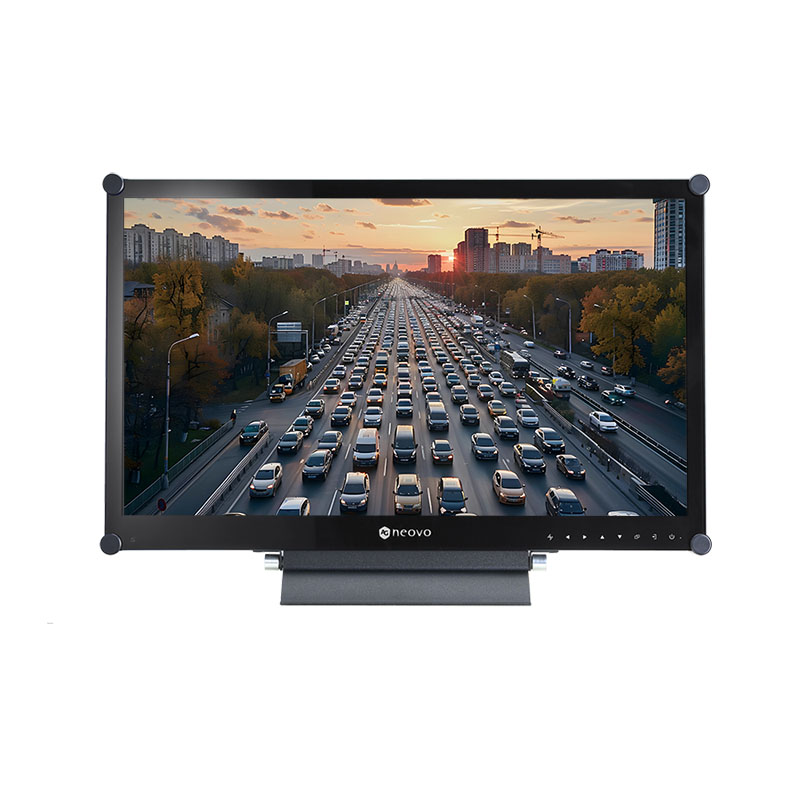
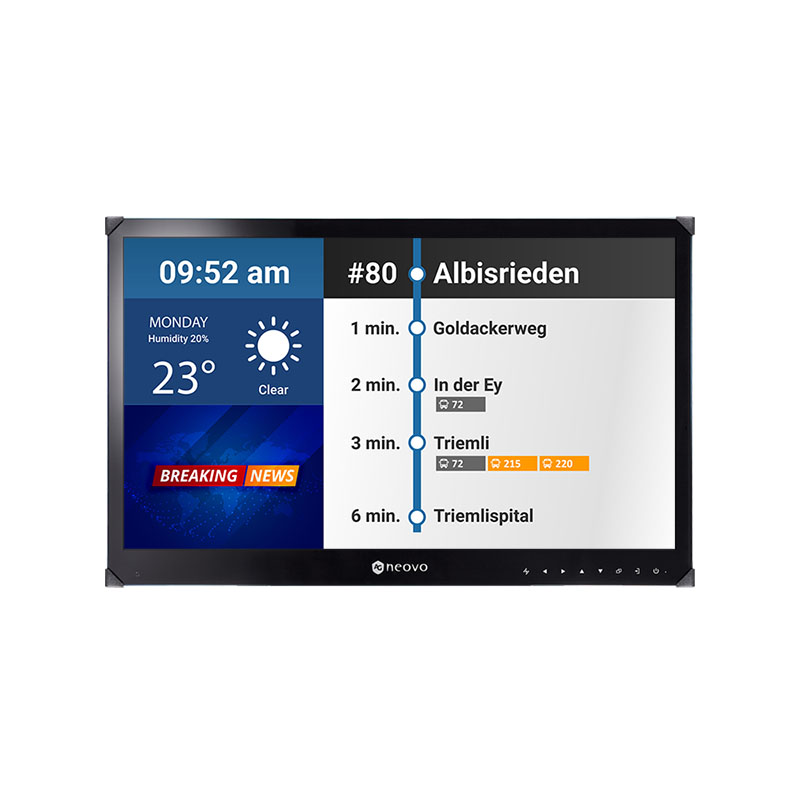


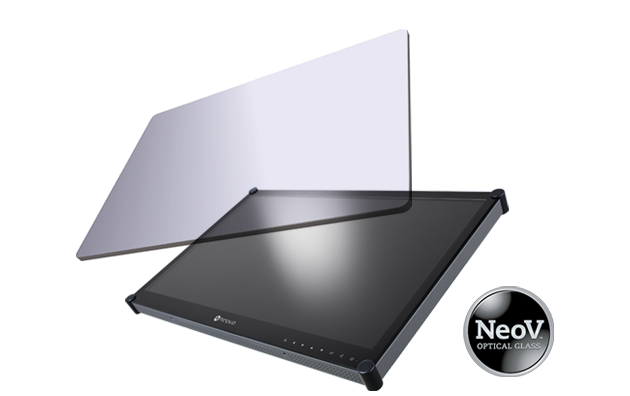 NeoV™ Optical Glass Screen
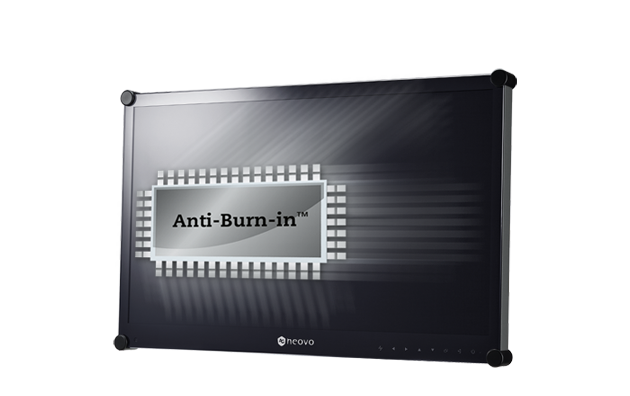 Anti-Burn-in™ Technology